The ONG Jiu-Jitsu movement—also known internationally as NGO Jiu-Jitsu—exists for one simple reason: talent should never be blocked by lack of access. This month, that mission became tangible in one of the most meaningful ways possible. Through the Jiu-Jitsu for Good initiative, more than 400 kimonos (gis) were delivered in Brazil and directed to social projects in the state of Rio de Janeiro, impacting children and teenagers who rely on these programs not only for training, but for structure, safety, and opportunity. ([Graciemag][1])
This was not a symbolic gesture. It was a coordinated, international mobilization—built with discipline, teamwork, and logistical execution—designed to generate immediate impact. The delivery took place in Nova Iguaçu, in Rio de Janeiro’s metropolitan area, where the tatami became the stage for a moment that represents much more than uniforms: it represents access. ([Graciemag][2])
Why “ONG Jiu-Jitsu” Matters
In many communities across Brazil, social projects and smaller academies operate with limited resources. Coaches and volunteers can have structure, talent, and commitment—but still face a very basic barrier: equipment. A quality gi can be cost-prohibitive for low-income families. When a young athlete cannot afford a uniform, the outcome is direct and painful: they delay training, stop attending, or never begin.
That is why ONG Jiu-Jitsu is not about charity for the sake of charity. It is about removing a barrier that prevents participation, and replacing it with a pathway that allows children to stay on the mat consistently—long enough for discipline to form, confidence to grow, and opportunities to emerge.
The Collaboration Behind the Delivery
This action was possible because multiple academies and partners chose to act together. The mobilization was led by U.S.-based Jiu-Jitsu schools that collected the gis and coordinated the delivery to Brazil as part of the Jiu-Jitsu for Good initiative. ([Graciemag][1])
The project counted on the active participation and leadership of the following academies:
- Athlas Training Team (@attftl)
- Alliance Key Biscayne (@alliancekb)
- Elementum Jiu-Jitsu (@elementumjiujitsu)
- Jiu-Jitsu 4 Life Coral Springs (@jiujitsu4lifecoralsprings) ([Graciemag][1])
When academies collaborate at this level, the result is bigger than any single school could accomplish alone. Each partner contributes a unique strength—student engagement, community reach, operational support, credibility, and consistency. Together, that creates scale.
Logistics: The Difference Between Intention and Impact
International giving is not only about generosity; it is also about execution. Shipping hundreds of gis from the United States to Brazil is not simple, and the costs can make large-scale donation efforts unrealistic.
To make this delivery feasible, the operation relied on a critical partnership with IMT Logistics (@imtlogistics)—a company specialized in transportation between the U.S. and Brazil—helping overcome the high cost of international freight and ensuring the material reached the intended recipients. ([Graciemag][1])
In practice, this partnership did more than “ship items.” It protected the integrity of the mission by ensuring the gis arrived in the correct destination, on time, and in a way that kept the project sustainable.
Where the Gis Went: Nova Iguaçu, Rio de Janeiro
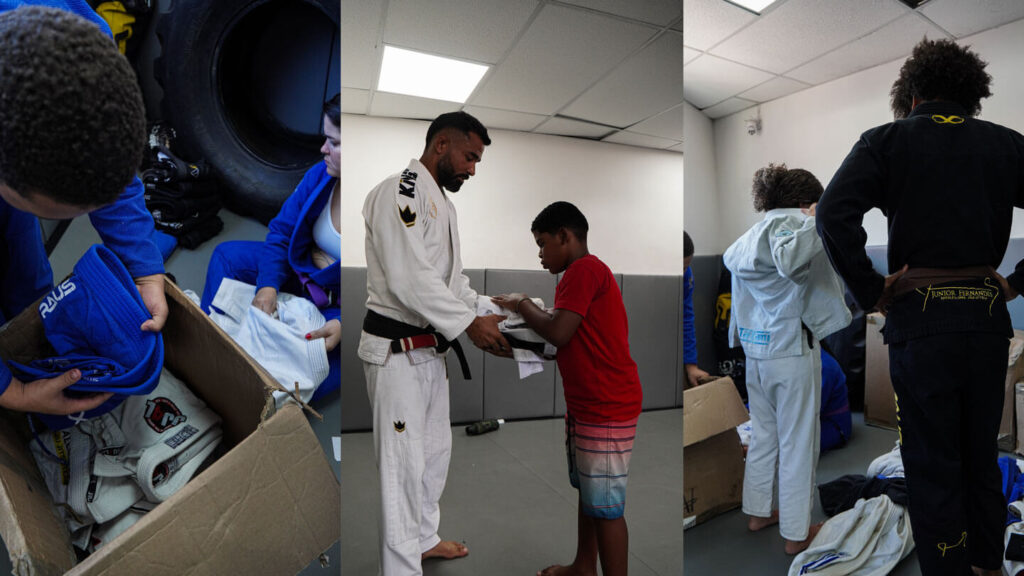
According to published coverage, the delivery took place on February 1 in Nova Iguaçu, in the Baixada Fluminense region, and the donation was directed to children and adolescents connected to local social projects. ([Graciemag][2])
For recipients, a gi is not just a uniform. It becomes:
- A requirement to train regularly
- A sign of belonging to a team
- A source of pride and identity
- A practical tool that prevents dropout caused by lack of equipment
The mat is one of the few environments where socioeconomic differences can fade—if access exists. With a gi, a young athlete can show up, line up, and learn, without being excluded by circumstances outside their control.
How the Idea Was Born: Seeing the Problem Up Close
The origin of this project came from direct observation of the difficulties faced by Brazilian athletes—especially those outside major hubs of the sport. Coverage highlights that the concept grew from witnessing how common the lack of basic gear is within social projects and smaller academies. ([Graciemag][1])
This reality became even clearer behind the scenes at high-level events. In international competitions, athletes often speak openly about barriers they face at home—especially in regions where the sport is strong culturally, but support resources are weak economically. When talented athletes express that training is limited by something as fundamental as a gi, the community is confronted with a direct responsibility: either we accept the barrier, or we remove it.
The Social Impact of 400+ Gis
A large donation can be measured by numbers, but its true value is measured by outcomes. Over 400 gis delivered means:
- More children can start training immediately.
- More teenagers can stay consistent longer.
- Coaches can build stable classes without constant equipment loss.
- Projects can redirect limited funds into mats, facility upkeep, and events.
And beyond the gym, consistent martial arts training supports:
- discipline and routine
- emotional regulation
- healthier peer relationships
- resilience under pressure
- mentorship and positive adult role models
These are not abstract ideals. They are daily outcomes that become visible when a child is present, training, and supported.
Why This Was a Community Achievement
One of the most important aspects of this story is that it was not built as a single-brand effort. It was built as a community mission—a coalition of academies, students, partners, and supporters aligned behind a shared outcome: helping social projects in Rio de Janeiro through immediate, practical resources. ([Graciemag][1])
This matters because the Jiu-Jitsu community is global. When international academies work together, they demonstrate that the sport’s identity goes beyond competition and beyond geography. It becomes a network of people capable of delivering real-world solutions.
Media and Documentation: Why Public Records Matter
The impact of a project increases when it is documented clearly and responsibly. Public coverage and official posts serve several purposes:
- They validate the work with a permanent reference
- They encourage accountability and transparency
- They inspire other schools to replicate the model
- They attract future logistical and institutional partners
This delivery received recognition through published reporting and official social media documentation of the initiative. ([Graciemag][1])
What This Action Represents for Jiu-Jitsu for Good
Jiu-Jitsu is often described as a “lifestyle,” but what makes it powerful is that it changes behavior through repetition: show up, train, improve, respect the process. Social projects do the same—often with far fewer resources.
By delivering 400+ gis, Jiu-Jitsu for Good reinforced a principle that should define the sport at every level: the mat must remain open to those with the least access, not only those with the most resources.
And this is precisely what ONG Jiu-Jitsu means in practice: taking responsibility for access, and converting community strength into measurable outcomes.
Conclusion
The delivery of more than 400 kimonos to social projects in Rio de Janeiro was a decisive demonstration of what the Jiu-Jitsu community can achieve when it acts with unity, organization, and purpose. It combined the mobilization of U.S.-based academies with the essential role of logistics partners to ensure the donation reached the people it was intended to serve. ([Graciemag][1])
Most importantly, it delivered something that many young athletes never get a fair chance to receive: access to begin, and the resources to continue. The ONG Jiu-Jitsu movement stands as a clear example that Jiu-Jitsu can build champions—but it can also build opportunity, dignity, and long-term social impact.
1) https://www.graciemag.com/academias-dos-eua-se-unem-para-doar-400-kimonos-a-projetos-sociais-no-rio/
2) https://www.instagram.com/p/DUT7EpJDiI5/?igsh=bGR4ODhrOWF1a2c3

0 Comments